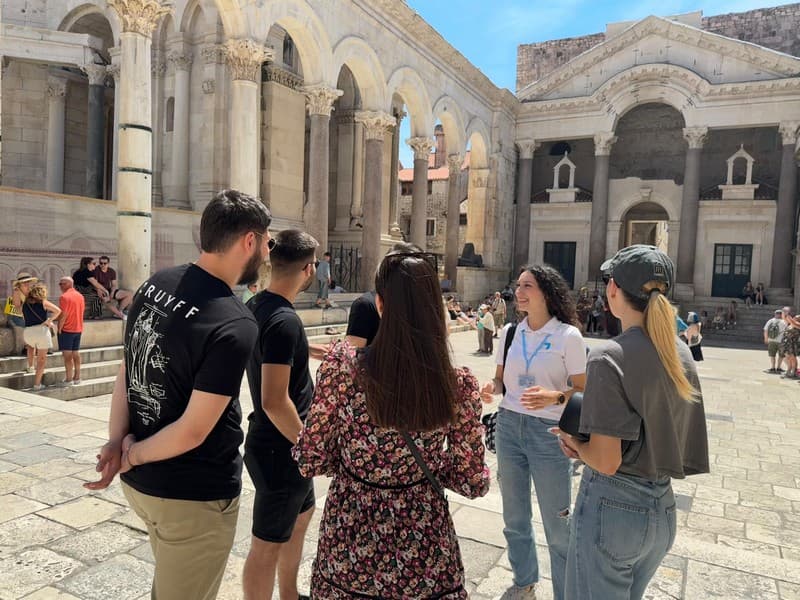
Split Walking Tour: The Best Guided Tours of Diocletian's Palace (2026)
Why You Need a Guide for Diocletian's Palace
Diocletian's Palace is one of the most complex ancient sites in the Mediterranean. It's not a ruin you walk around the outside of — it's a living city where 3,000 people still live inside the original Roman walls. Cafés, apartments, and churches are built directly into 1,700-year-old Roman architecture. Without context, it's just a lot of old stone.
A good guide changes that completely. The history of a Roman emperor choosing Split as his retirement destination — why here, what he built, how it became the city it is today — is genuinely one of the most interesting urban stories in Europe. You just need someone to tell it to you properly.
What a Good Walking Tour Covers
The Peristyle: The ceremonial square at the centre of the palace — the formal entrance to Diocletian's private apartments. Still in use as a public square, with the Cathedral of Saint Domnius (Diocletian's converted mausoleum) rising from one end. A guide will explain how a Roman emperor's tomb became a Christian cathedral, and why that conversion happened.
The Underground Cellars (Podrumi): The subterranean ground floor of the palace, which exactly mirrors the layout of the rooms above. The rooms above are mostly gone; the cellars are among the best-preserved Roman interiors in the world. You can walk through the full extent of the palace's original footprint underground.
The Cathedral Tower: Climbing it takes five minutes and gives you an aerial view of the entire palace complex — you can see how the Roman grid plan still shapes the streets of the modern city.
The hidden stories: Which narrow alley was the original Roman main street. Where the palace gates are (Gold, Silver, Iron, Bronze). Which building in the palace complex is actually older than the palace itself. These are the details that only come with a guide.
Tour4You Walking Tour: What We Recommend
The Tour4You Split Walking Tour is one of the best licensed tours of the old town available. It's small group (up to 15 people), English-language, and led by a licensed local guide who knows the palace the way a local does — not just the official highlights but the stories and context that make the history feel immediate rather than distant.
The tour takes about 2 hours and covers the essential sections of the palace on foot. Meeting point is the Riva promenade, next to the bronze model of Split's old town. No need to arrange transport — the palace is a 2-minute walk from anywhere on the waterfront.
Price: €25 per person. With Adriatic Pass, 15% off — bringing it to €21. See the tour details →
Best Time for a Walking Tour
Early morning (9-10am) and late afternoon (5-6pm) are best. The palace gets busy at midday in summer — narrow alleys with tour groups moving in both directions makes it hard to hear the guide and enjoy the space. The morning tour also gives you the rest of the day to explore independently once you have context.
In July and August, the palace is genuinely crowded at peak hours. If you're visiting in those months, book the earliest available slot.
What to Do After the Tour
Once you've done the guided tour, you have the context to explore independently. Go back to the sections that interested you most. Sit at the Peristyle and watch the light change. Walk through every gate. Have coffee inside the palace walls at one of the konobas tucked into the Roman arches.
The underground cellars cost €10 to enter independently and are worth it — the guided tour may pass through them, but spending 30 minutes exploring on your own adds depth.
Adriatic Pass
Ready to explore the Adriatic for less?
One pass. 75+ experiences. Exclusive prices across Split, Hvar, Brač & Makarska.
Get Your Pass →