Diocletian's Palace Split: The Complete 2026 Guide
What Is Diocletian's Palace?
Diocletian's Palace is not a museum. It is a living neighbourhood where 3,000 people still live and work inside walls that were built in the 4th century AD. Restaurants, bars, apartments, the cathedral, the bishop's palace — all of it is inside a Roman fortification that has been continuously inhabited for 1,700 years. There is nothing else quite like it in the world, which is why it's a UNESCO World Heritage Site and why it was chosen as a filming location for Game of Thrones.
Most visitors spend two hours here. The ones who understand what they're looking at could spend two days.
Brief History
Emperor Diocletian was born near Salona (modern Solin, just outside Split) and built this palace as his retirement residence around 305 AD — one of the very few Roman emperors to abdicate the throne and live out his days peacefully. The palace covers about 30,000 square metres and was originally designed to house up to 9,000 people, including soldiers, servants, and the emperor's household.
After the fall of Rome, the palace was gradually taken over by refugees from Salona fleeing barbarian raids. The Roman rooms became homes. The mausoleum became a cathedral. The temples became churches. The identity of Split as a city grew entirely from within these walls.
What to See Inside the Palace
The Peristyle
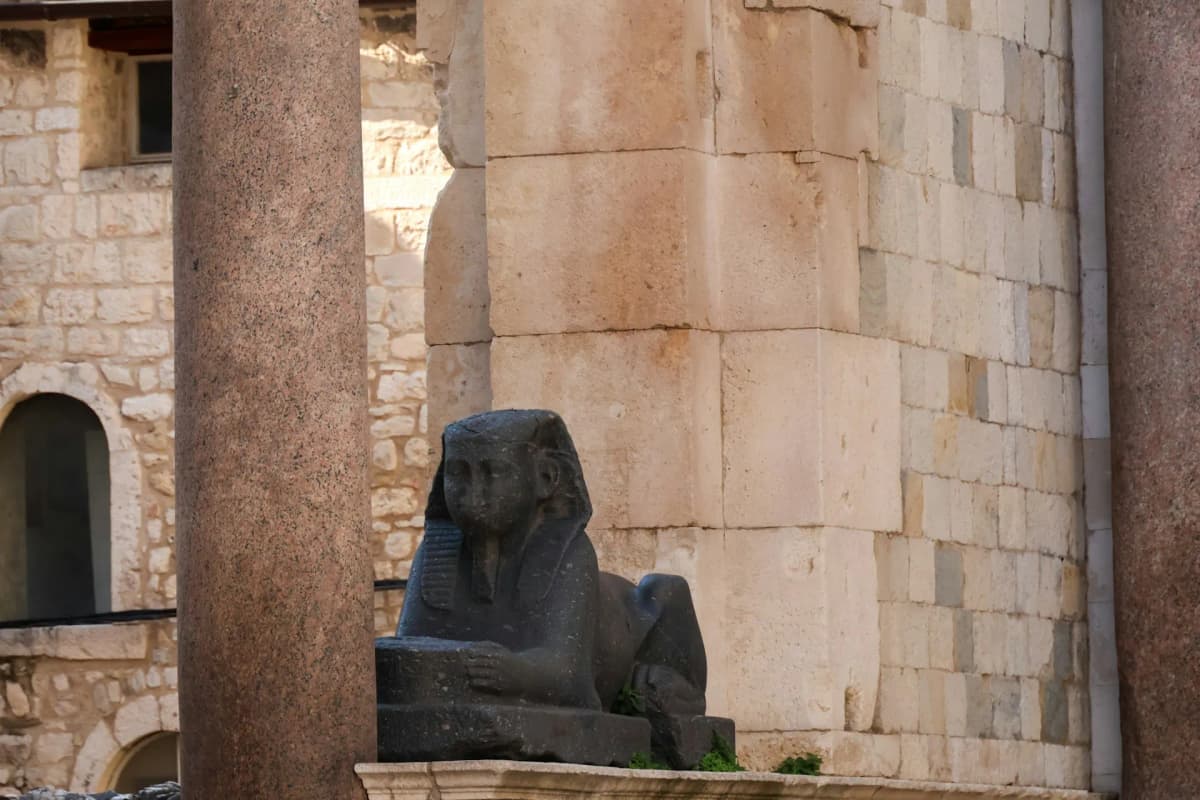
The main ceremonial square, flanked by columns, with the cathedral at one end and the Vestibule at the other. This is the heart of the palace and the best place to feel the scale of what Diocletian built. The café on the Peristyle has been there since 1908 and is the best seat in any Roman ruin on earth.
The Cathedral of Saint Domnius
Originally built as Diocletian's mausoleum, converted to a Christian cathedral in the 7th century — specifically to commemorate a bishop that Diocletian had executed. The irony is noted. The interior retains its octagonal Roman form. The bell tower (built in the 12th-16th centuries) offers the best panoramic view in Split. Entrance to the tower: €5.
The Underground Cellars (Podrumi)
Directly beneath the southern half of the palace, the cellars were used for storage in Roman times. They are some of the best-preserved Roman cellars in existence. Walking through them gives you the exact floor plan of the palace above — where the emperor's dining room was, his private apartments, the ceremonial spaces. Open from 8am. Entrance: around €10.
Jupiter's Temple
The best-preserved Roman temple in Croatia, now also converted to a chapel. The carved ceiling is extraordinary. Free to view from the vestibule, small entry fee inside.
The Gates
The palace has four gates — Golden (north), Silver (east), Bronze (south, opening onto the sea), and Iron (west). The Golden Gate is the most impressive, opening onto a large square with a massive statue of Bishop Gregory of Nin (rubbing his big toe is said to bring good luck). The Bronze Gate opens directly onto the Riva waterfront — walk through it and you're standing on the sea.
Best Times to Visit
Early morning (7:00 – 9:00am): The best time by far. The light is soft, the streets are quiet, and you can actually hear your own footsteps on the same stones Diocletian walked. Cafés start opening around 7:30am.
Late evening (after 7:00pm): The palace at dusk, with the limestone glowing warm and the restaurants filling up around the Peristyle, is genuinely magical. This is when the city comes alive again after the afternoon heat.
Avoid: Midday in July and August. Tour groups are at maximum density and the heat inside the walled streets is intense.
VR Tour: Time Walk
For history enthusiasts, the Time Walk VR experience reconstructs the palace as it looked in 305 AD — soldiers, merchants, the original decor, the sounds of Roman daily life. You walk through the real streets while seeing the Roman version overlaid through the headset. Takes about 45 minutes. Available at several points in the old town. With Adriatic Pass: 15% off.
Practical Information
Getting there: Split old town is walkable from the bus station (5 min), ferry terminal (2 min), and most accommodation in the centre. The palace is impossible to miss.
Free areas: The streets of the palace, the Peristyle, and the gates are all free to walk through at any time. You only pay to enter specific attractions (cathedral, tower, cellars).
Getting lost: Strongly recommended. The street grid inside the palace is intentional chaos — there are corners where you can stand in silence and feel 1,700 years of history pressing in from every direction. Budget time for it.
Adriatic Pass covers discounts on the VR tour, guided walking tours, and 30+ other Split experiences.
Adriatic Pass
Ready to explore the Adriatic for less?
One pass. 75+ experiences. Exclusive prices across Split, Hvar, Brač & Makarska.
Get Your Pass →